
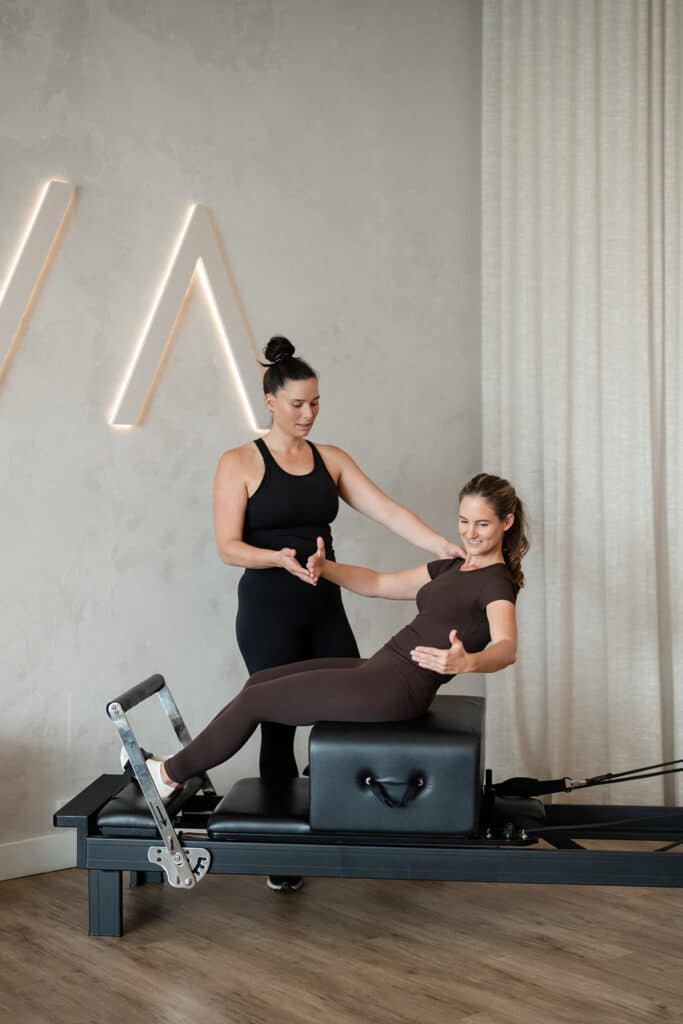
Why Anatomy Matters in Pilates Instruction
The beauty of Pilates lies in mindful movement, control, breath, alignment – but to teach it safely and effectively, you need more than memory of exercises. You need to understand what lies beneath the skin: muscles, joints, posture, biomechanics. That’s why at VIVA Pilates Education we emphasise anatomical knowledge as a key pillar of instructor training.
The Role of Anatomy in Safe & Effective Pilates Teaching
-
Postural Analysis & Alignment
Every body is different. Some clients may have tight hip flexors, others weak glutes; some might have imbalances, previous injuries or unique skeletal structure. Understanding anatomy helps you assess posture, identify misalignments or muscle imbalances – then adapt exercises or offer modifications accordingly. At VIVA, our curriculum covers theory and practice of postural analysis to make instructors competent in tailoring Pilates to individual needs.
-
Injury Prevention & Rehabilitation Support
Pilates is often chosen by clients for rehab, recovery or injury prevention. A strong anatomical grounding helps instructors recognise when an exercise might be too intense for a client, understand how movement affects joints and muscles, and adjust or scaffold the exercise properly. This protects clients from harm and promotes long-term wellness – a must in 2026’s health-conscious world.
-
Teaching with Precision – Cueing, Modifications & Progressions
When you know how muscles engage, where stabilisers should act and what joint ranges are safe, your verbal and tactile cues become far more precise. That leads to better outcomes for clients. It also lets you confidently progress or regress exercises depending on a client’s strength, mobility, or limitations – making you a more skilled, versatile instructor.
-
Building Credibility and Professionalism
As the Pilates industry grows, clients expect professionalism and safety. Instructors who can demonstrate anatomical understanding stand out – they are trusted to work with diverse populations (beginners, pregnant clients, older adults, rehab clients, athletes). At VIVA, our training isn’t just about memorising moves – we teach the “why” behind every move.
Important – Anatomy Isn’t Optional, It’s Essential (Even if Some Try to Skip It)
Sadly, some Pilates classes out there are taught by instructors with minimal training – perhaps just a weekend or short “certification,” sometimes without deep anatomical education. As one user on Pilates forums recently put it:
“I honestly feel there are major safety concerns with instructors lacking legitimate certifications. It also waters down Pilates as a whole.”
Without anatomy knowledge, instructors may overlook misalignments or pad over poor form. That can lead to ineffective sessions – or worse, client injury or dissatisfaction.
VIVA’s Solution – Training with Depth, Support & Ongoing Learning
At VIVA Pilates Education, our teacher-training courses (Matwork and Reformer) provide a balanced and thorough blend of theory, observation, and practical experience – including postural analysis, correct alignment, safe movement, modifications, and over 120 exercises.
We also support ongoing learning and mentorship to help instructors deepen their understanding, refine their cueing and adapt to different clients over time. Because Pilates isn’t a “set-and-forget” method – it evolves with each body, each student, and each instructor’s growth.
If you want to advance in your Pilates teaching while learning additional measures to plan classes confidently, and safely – then yes, you need to understand anatomy. At VIVA, we’re here to support you every step of the way.
Ready to start building a deep, anatomy-informed Pilates teaching practice?
Check out our upcoming course dates and sign up for the next intake.
